Academic & Social Framework
At the core of all Montessori education is human development. She believed that education should not only build knowledge and skills, it should serve the needs of natural human development from infancy to adulthood. If education served this larger purpose, learning would become a natural process of discovery and self-construction, rather than a repetitive cycle of direct instruction and testing.
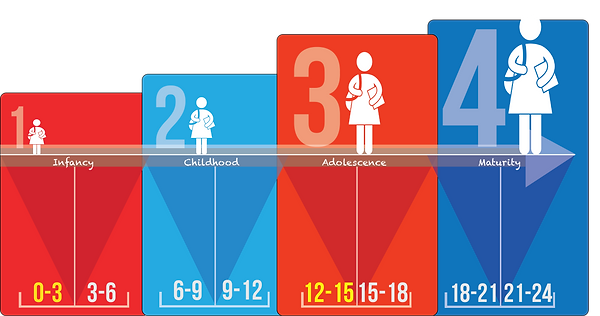
This graphic represents one of the ways Dr. Montessori would explain human development from birth to age 24. She believed that humans tend to develop from infants to fully independent adults in a series of four stages, or planes, each lasting around 6 years. Each plane has its own unique characteristics and sensitivities, therefore each needs its own unique environment for learning and growth--one that is responsive to the unique needs of that age.
I think of them like the four seasons of a year. Each season has its own character, its own recreation, its own challenges, its own feeling. For example, in Ohio, where we're from, it doesn’t make much sense to learn skiing in the summer or to try fly-fishing in the winter—one’s activities must be conducive to the season they are in.
In the graphic, the first and third planes are red because she believed these to be the most dynamic stages of growth. When you place a newborn infant next to their 6 year old self, you'll see an incredible difference. So much physical and intellectual growth occurs very rapidly in those 6 years. The same is true of 12-18 (adolescence).
-25.jpg)
-31.jpg)
-7.jpg)
Adolescence is a dynamic moment in the development of a human being. During this stage, the mind begins to completely "re-wire" itself as it begins the transition into adulthood. The mind of the elementary child, which was wide open to taking in the whole universe through an active imagination, gradually begins to become more grounded in reality…in the here and now…in human society and culture and the ways that humans interact with one another on personal and global levels.
It’s an important time for moral and social development. Empathy, compassion, justice—the adolescent is sensitive to these things as they begin to observe the adult world around them like never before.
The role of education for this critical time should be to provide the proper environment in which:
-
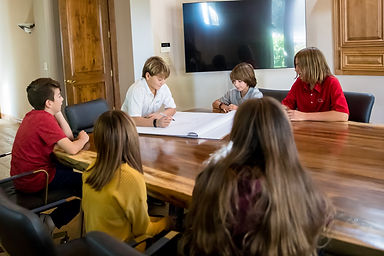
Adolescents can form an authentic community of peers and adults
-
They can create their own ethics and expectations of one another
-
They can learn economic independence through operating a business
-
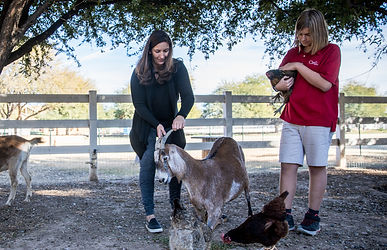
Learning is purposeful because it is connected to their community, their business, and the land (farm) they share
-
They can nurture their natural drives to socialize through frequent collaboration
-
They can reflect on their own growth and experiences communally and independently
-
They can be trusted with ever-greater responsibility, which is balanced with ever-greater freedom and independence
-
They can set their own learning goals and take ownership of their education
-
They can be coached and advised through the more difficult times of adolescence
-
Rich and meaningful experiences provide the impetus for social, moral, intellectual, and physical development
This type of environment was outlined in Dr. Montessori's From Childhood to Adolescence. She refrained from designing specific lessons and materials like she did for earlier childhood classrooms, because she knew each community would be unique and driven by different needs and interests that should in-turn drive the learning itself.
Her outline, however, is rich with purpose and detail. She first provided a framework for the social organization of an adolescent program, explaining the roles of adults and students, the need for community life, the importance of running a business, and named the ideal location for purposeful work and study as a farm.
She then went on to describe the "educational syllabus." Her Educational Syllabus is sound and comprehensive as it meets the intellectual and developmental needs of the adolescent through:
-
Self-expression, through
-
Physical activity
-
Art
-
Language (creative writing, acting, etc.)
-
-
Psychic formation (note: the word "psychic" here refers to the intellect, not supernatural abilities) , which consists of
-
Mathematics
-
Language (domestic and world)
-
Moral development
-
-
Preparation for adult life, which includes
-
All of the sciences
-
Humanities (history, geography, the arts, religion, civics, etc.)
-
Along with the social organization she laid out, all adolescent programs regardless of location, cultural context, and circumstances, must fulfill these requirements of Dr. Montessori’s plan—albeit in their own unique ways. And, regardless of details, they should all strive to provide environments that ultimately promote meaningful, engaging work that combines the head (intellect) and the hands (manual activity), and one that balances freedom and independence with discipline and responsibility.