
Integrated Language Arts
The adolescent program at Creo fosters language development by providing and cultivating various forms of expression—both written and oral. The adolescent is encouraged to focus on their own personal responses to some of the greatest uses of language in human history—from literature to speeches to profound works of poetry and music as well as political cartoons and current editorials from the local newspaper. Discovering their ability to respond on a personal level helps them to become more engaged in the development of their own voice and of their own power to shape themselves and their communities through language. This engagement naturally fosters analytical and critical thinking skills that will be valuable in all aspects of their adult lives.
Maria Montessori viewed language as a key to healthy social interactions and responsible citizenship. As such, language development in the middle school is cultivated both as a tool of personal and community life and as an academic field to be mastered. As such, along with explanatory and persuasive essays, students also learn the value of speaking with confidence, the importance of grace and courtesy in a community, as well as how to communicate effectively in various interpersonal situations.
As an intellectual, creative, and social process that is woven into the fabric of everyday life, the art of language permeates all aspects of the Montessori plan for study and work. It is intentionally integrated across the disciplines through the development of research skills, formal presentations, reading and writing assignments, journaling and seminars.
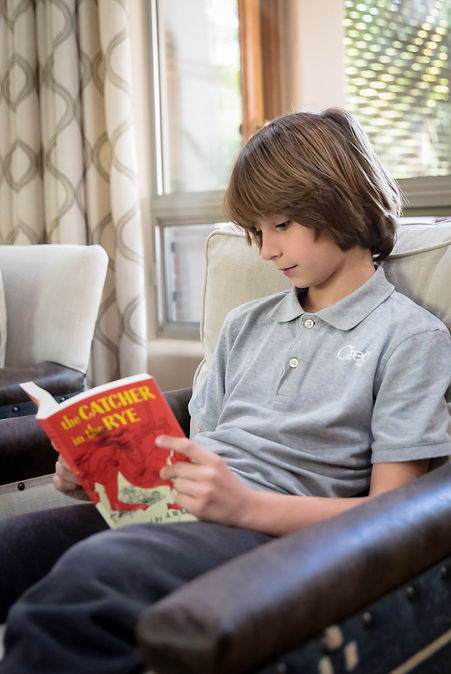
Literature plays a large role in the Language Arts program as students are nearly always engaged in the reading of a novel, short stories, informational texts, or nonfiction books. Readings are explored through brief background lessons, literary analysis assignments, detailed descriptions of characters, thematic essays, in-class writing prompts for comprehension checks, factual quizzes, and, ultimately, formal student-led seminars.
Reading choices purposefully relate on a thematic level with topics being explored in Humanities and/or Science, which helps the adolescent to recognize and understand the interconnectedness and richness of the human experience. Literature discussions occur weekly and a formal seminar is led by students at the end of each novel.
Poetry, in all of its forms, is also a large focus throughout each year. The adolescent is particularly sensitive to the power of poetry and its ability to express their developing personalities and increasingly complex emotions. A variety of poetic styles, voices, and themes are introduced through reading and writing throughout the year.
In addition, drama is a crucial element of the Integrated Language Arts curriculum. Students read, study, view, and participate in several theatrical experiences throughout the year in conjunction with their Humanities studies and literature selections. Drama allows the adolescent to deepen their sense of empathy by placing themselves in the metaphorical “shoes” of another. As a community-based activity, it requires the utmost engagement and participation from each student. Their dramatic work is professional, polished, and completely student developed.
Aside from being an essential and integrated complement to all academic disciplines, the art of language is explored when participating in student government (“Council”), when communicating with peers, staff, and customers on behalf of the microeconomy, when writing creatively for personal expression, and when learning proper etiquette and expression within the school community and on trips and outings.
On a practical level, adolescent students grow into an understanding of the power of their voice in every situation—academic, professional, and casual. Language gives form and meaning to their connection to one another and to the world.
Writer’s Workshops
To help facilitate the mastery of the English language, an adult guide provides concentrated instruction and coaching during formal sessions called Writer’s Workshop. Students receive group and one-on-one lessons related to grammatical conventions, vocabulary, business literacy, poetry, and other diverse forms of writing and speaking while also having independent time to practice their developing skills.
Throughout these workshops, writing is emphasized as being primarily a process rather than a product. Formal essays, articles, summaries, presentations, and creative writing assignments frequently accompany their explorations of language, and typically begin in a prewriting stage before advancing into multiple drafts that occur in rapid succession through meaningful edits made by peers, the guide, and the student writer.
-9.jpg)
.jpg)
-5.jpg)

Writing Overview
Most of the forms of writing listed below are explored and practiced over the course of two years in the adolescent program. Some are required, while others are suggested styles that are recommended when students are given the freedom to choose a writing style that interests them in the moment. A writing folder is kept for each student’s completed written work, including drafts that reveal their efforts in the writing process. Within a two-year cycle, many of these forms of writing will be accomplished multiple times. Students are always writing.
Paragraph Structure
-
Topic, body, and closing sentences
-
Paragraph unity and coherence
-
Paragraph development (description, example, incident)
Personal Writing
-
Journal writing
-
Self and Peer Evaluation
-
Personal Emails
-
Letter
-
Thank-you note
-
Blog posts
-
Freewriting
-
Travelogue
Narrative Writing
-
Personal Essay/ Narrative
-
Phase autobiography
-
Biographical essay
-
Descriptive essay
-
Graduation Speech
Explanatory Writing
-
Five-paragraph format
-
Research report
-
Expository Essay
-
How-To Essay
-
Comparison-Contrast Essay
-
Cause-Effect Essay
-
Classification Essay
-
Summary of news article
-
Math Table
-
Statistical Analysis
-
Science Lab Report
-
Response prompt
-
Timeline captions
Persuasive Writing
-
Persuasive Essay
-
Speech writing
-
Opening argument for debate
-
Position Paper
Journalistic Writing
-
News story
-
Feature Article
-
Editorial
-
Music/film/art/product review
-
Political cartoon
-
Interview
Business Writing
-
Social letter and email
-
Business letter and email
-
Thank you letter
-
Invitation
-
Advertisement
-
Marketing brochure
-
Business/product proposal
-
Script writing for phone calls
-
Resume
-
Cover letter
Writing about Literature
-
Theme essay
-
Literary analysis
-
Literary criticism
-
Character list/description
-
Response prompt
Creative Writing
-
Poetry (various styles)
-
Short Story
-
Dramatis persona
-
Play
-
Screenplay
-
Skit
-
Fable
-
Myth
-
Legend
-
Rap
-
Song lyrics
-
Parody
-
Code (software, apps, websites)
Other Forms and Principles of Writing
-
Essay structure
-
Introductions and conclusions
-
Thesis statements
-
Five paragraph format
-
Unity and coherence
-
Transition sentences
-
-
Presentation notes
-
Taking notes during a lesson/presentation
-
Using quotations
-
Paraphrasing
-
Avoiding plagiarism
-
Peer and self-evaluation
Reading Overview
The following forms of reading are explored and practiced over the course of three years in the adolescent program. The majority of non-fiction reading occurs within Humanities and Science studies, while the majority of fiction reading occurs through a series of novels that are read throughout each year.
Novels are usually thematically related to studies in the Humanities and/or Science. Poetry, textbooks, and short-form readings occur frequently within the frameworks of Science, Humanities, Math, Microeconomy, Advisory, and Current Events. Students are always actively reading.
Emphasis is placed on their comprehension, personal responses, and critical analysis of all readings. Media Literacy is also emphasized over the course of two years, allowing students to question sources and validity of media, particularly information-based and web-based sources.
Research-Based and Informative Reading
Primary sources (Examples: Declaration of Independence, Law Code of Hammurabi, Plato’s Republic, letters, historic speeches, etc.)
Secondary sources (textbooks; standard non-fiction topic-based sources; journal, magazine, and internet articles)
Journalistic writing
Biographies & autobiographies
Memoirs
News articles
Editorials
Essays
Speeches
Instructional Manuals
Websites
Literature and Creative Writing
Novels
Novellas
Short Stories
Poetry
Plays
Music Lyrics
Graphic Novels
Literature Seminar Readings
The following list contains novels, biographies, memoirs, and historical texts that have been read collectively by students in the past for the purpose of holding literary seminars. Literature choices change from year to year, and the guides always remain open to new literature.
The Outsiders
To Kill A Mockingbird
Ishmael
A Separate Peace
Brainstorm: The Power and Purpose of the Teenage Brain
The Map of Salt and Stars
Anne Frank’s Diary
Fahrenheit 451
The Good Earth
Watership Down
The Book Thief
Our Town
Lord of the Flies
Girl with a Pearl Earring
October Sky
Travels with Charley
Macbeth
Romeo and Juliet
A Midsummer Night’s Dream
Things Fall Apart
A Long Walk to Water
Red Scarf Girl
The Jungle
1984
Tuesdays with Morrie
Siddhartha
All Quiet on the Western Front
A Tree Grows in Brooklyn
House of the Scorpion
The Alchemist
Inherit the Wind
Of Mice and Men
Tuesdays With Morrie
Frankenstein
The Metamorphosis
Ashes of Roses
Lyddie
Animal Farm
The Pearl
The Old Man in the Sea
Across Five Aprils
Same Sun Here
The Adventures of Huckleberry Finn
Life of Pi
The Slave Dancer
The Chosen
When Legends Die
Night
Sword in the Stone (Once and Future King)
The Warmth of Other Suns: The Epic Story of America’s Great Migration